

Journal of Clinical Pediatrics ›› 2025, Vol. 43 ›› Issue (7): 483-499.doi: 10.12372/jcp.2025.25e0564
• Standard · Protocol · Guideline • Next Articles
Chinese Cooperative Group for the Management of Pediatric Enuresis Affiliated to Pediatric Nephrology Committee of Chinese Medical Doctor Association
Received:2025-05-20
Accepted:2025-06-10
Published:2025-07-15
Online:2025-06-27
CLC Number:
Chinese Cooperative Group for the Management of Pediatric Enuresis Affiliated to Pediatric Nephrology Committee of Chinese Medical Doctor Association. Chinese expert consensus on management of nocturnal enuresis in children[J].Journal of Clinical Pediatrics, 2025, 43(7): 483-499.
Table 1
The terminology related to nocturnal enuresis"
| 术 语 | 定义 |
|---|---|
| 遗尿症(NE) | ≥5岁,平均每月至少1次夜间不自主排尿,并持续3个月及以上 |
| MNE | 患儿仅有夜间遗尿,不伴有日间LUTS |
| NMNE | 患儿不仅有夜间遗尿,还伴有日间LUTS |
| PNE | 自幼遗尿,没有6个月以上的不尿床期,并除外器质性疾病 |
| SNE | 之前已经有长达6个月或更长不尿床期后又再次出现尿床 |
| 预期膀胱容量(EBC) | <12岁时计算公式为:[(年龄+1)×30],单位mL;12~18岁为390 mL |
| 最大排尿量(MVV) | 24 h内出现的单次最大排尿量(早晨第1次排尿除外),该排尿量需在排尿日记中保持记录至少2天 |
| 夜间总尿量(TVV) | 包括入睡后夜间自主或不自主的排尿量(尿布增重或夜间起床排尿量)与清晨第1次尿量之和 |
| 夜间多尿(NP) | 夜间尿量超过同年龄段儿童预期膀胱容量130% |
| 膀胱过度活动症(OAB) | 一种以尿急症状为特征的症候群,可伴或不伴有急迫性尿失禁 |
| 日间LUTS | 日间发生漏尿、尿频、尿急、排尿次数减少、排尿困难、尿线中断或排尿中断 |
| 漏尿 | 多指白天不自觉将尿液排出体外 |
| 尿频 | 日间排尿≥8次·d-1 |
| 尿急 | 突然、意想不到和急迫的排尿 |
| 日间排尿次数减少 | 日间排尿<4次·d-1 |
| 排尿困难 | 排尿踌躇(排尿犹豫、启动困难)、尿流速缓慢,排尿费力、需按压以促进排尿 |
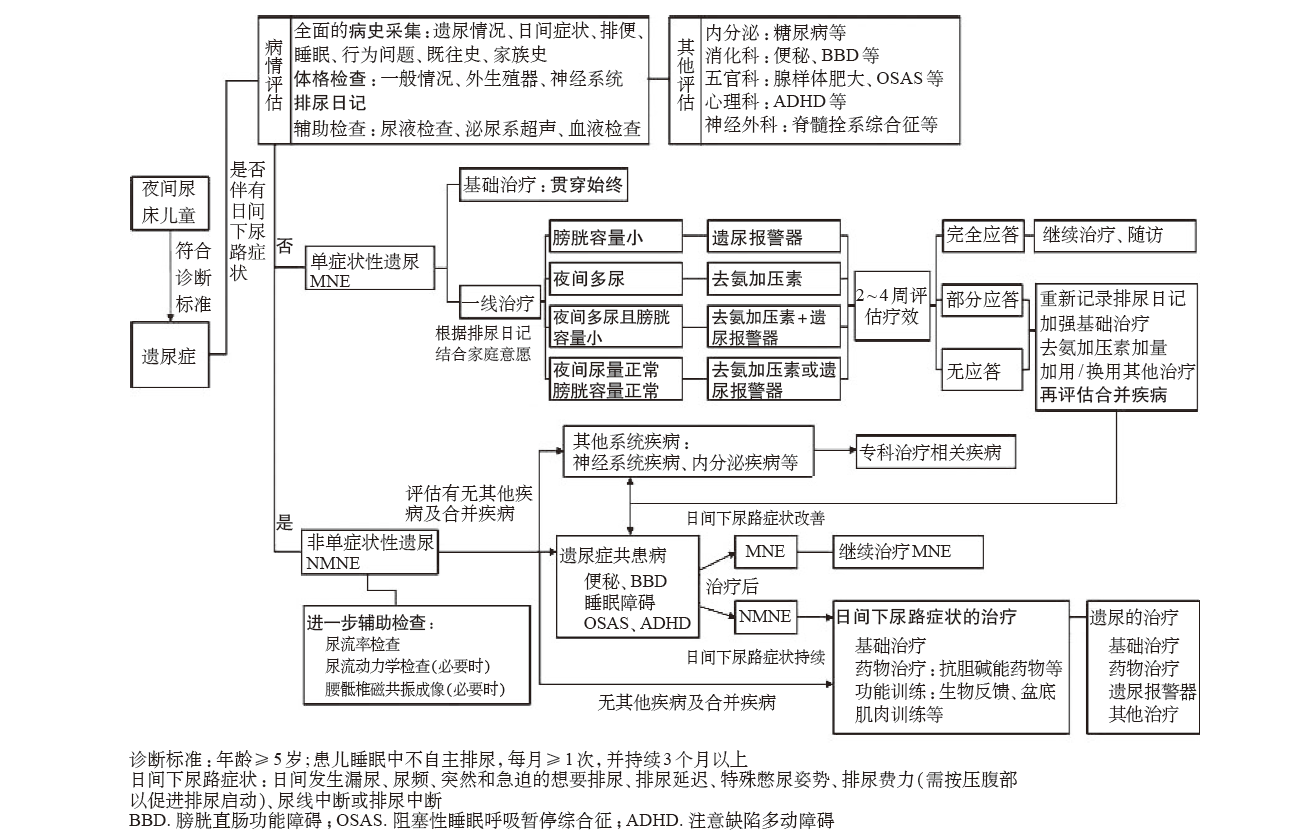
Figure 1
Management pathway for children with nocturnal enuresis"
"
| 病史 | 结果 |
|---|---|
| 儿童是否夜间睡眠中尿床(提示严重度、治疗方法及预后) | □是 □否 |
| 1. 每周尿床的夜晚数: | 夜/周 |
| 2. 每晚尿床的次数: | 次 |
| 3. 每晚尿床时间(大致时间) | |
| 4. 尿意-觉醒功能:①排尿完毕后仍未醒,②排尿完毕后立即觉醒,③排尿超过一半觉醒,④排尿开始即觉醒,⑤有尿意即觉醒) | 选择: ①②③④⑤ |
| 5. 每晚遗尿量(可通过测量尿布增重进行计量) | g/ mL |
| 日间下尿路症状(以下症状提示膀胱功能障碍) | |
| 1. 日间发生的漏尿(提示膀胱活动过度/非单症状性遗尿) | □是 □否 |
| 内裤上的尿渍 | |
| -排尿前 | □是 □否 |
| -排尿后 | □是 □否 |
| 严重尿湿内裤(内裤非常湿) | □是 □否 |
| 漏尿频率(每日发生次数): | 次/天 |
| 每日间断或持续的漏尿 | □是 □否 |
| 3岁半以后的日间尿失禁病史 | □是 □否 |
| 2. 尿频(排尿次数每日≥8次) | □是 □否 |
| 3. 尿急,即突然和急迫的想要排尿(提示膀胱活动过度) | □是 □否 |
| 4. 日间排尿次数减少(<4次/日,提示排尿功能障碍) | □是 □否 |
| 5. 特殊憋尿姿势(如文森特氏屈膝礼-儿童突然停止活动,脚尖站立,双脚用力交叉或采取蹲位,脚后跟顶着会阴部) (提示排尿功能障碍) | □是 □否 |
| 6. 需按压以促进排尿 | □是 □否 |
| 7. 尿流中断,或一次接一次的数次排尿(提示排尿功能障碍) | □是 □否 |
| 8. 泌尿道感染病史(常与潜在的膀胱功能障碍相关) | □是 □否 |
| 9. 疾病和/或畸形 | |
| 泌尿道 | □是 □否 |
| 脊髓/神经系统 | □是 □否 |
| 合并症-可能预测治疗抵抗的因素 | |
| 1.存在以下排便症状或病史(可预测治疗抵抗:便秘治愈可能致遗尿症的治愈) | |
| 便秘(每周排便≤3次) | □是 □否 |
| 内裤上的大便痕迹(大便失禁) | □是 □否 |
| 2.存在心理/行为/精神问题,如注意缺陷多动障碍(ADHD)、孤独症谱系障碍(ASD)的证据(可预测治疗抵抗) | □是 □否 |
| 注意力不易集中、注意短暂 | □是 □否 |
| 活动过多 | □是 □否 |
| 情绪易冲动 | □是 □否 |
| 社会交往、交流障碍 | □是 □否 |
| 兴趣狭窄 | □是 □否 |
| 刻板重复的行为方式 | □是 □否 |
| 3.运动障碍和/或学习障碍和/或精神运动发育障碍的病史(可能提示中枢神经系统病变) | □是 □否 |
| 4.睡眠问题 | |
| 夜间睡眠时间 | |
| 早上起床时间 | |
| 是否有入睡困难,唤醒困难、多梦、白天嗜睡 | □是 □否 |
| 是否有严重打鼾和/或睡眠呼吸暂停 | □是 □否 |
| 饮水习惯 | |
| 1. 是否常喝饮料 | □是 □否 摄入量及类型: |
| 2. 晚间(睡前2~3小时内)是否饮水 | □是 □否 |
| 3. 晚间(睡前2~3小时内)饮水量超过200 mL | □是 □否 |
| 4. 晚餐是否饮用牛奶或晚餐进食粥、汤类食物 | □是 □否 |
| 5. 晚间是否食用有利尿作用或含水量多的水果(如西瓜等) | □是 □否 |
| 家族史和既往史 | |
| 1. 遗尿家族史(包括父母、同胞及其他亲属) | □是 □否 |
| 2. 既往泌尿系感染史 | □是 □否 |
| 3. 既往脊髓/泌尿系手术史 | □是 □否 |
| 4. 服用影响排尿的药物(如螺内酯、呋塞米等) | □是 □否 |
| 5. 既往遗尿的治疗方式 | 无治疗 有,治疗方式: |
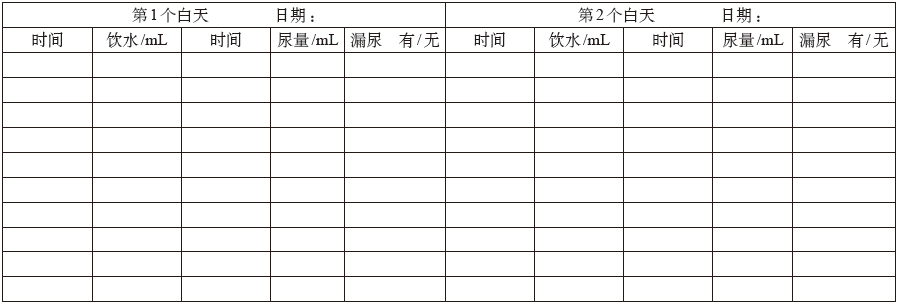
Table 2
Diagnostic questions to identify LUTS"
| 白天的漏尿情况 |
| 内裤上几滴尿: |
| -排尿前 |
| -排尿后 |
| 内裤非常湿 |
| 漏尿频率(次·d-1) |
| 每天间歇性或持续性漏尿 |
| 3岁半以后的日间尿失禁史 |
| 尿频(≥8次·d-1) |
| 日间排尿次数减少(<4次·d-1) |
| 突然和急迫的想要排尿 |
| 憋尿动作(例如交叉双腿、脚后跟顶着会阴部等) |
| 需要按压以促进排尿(排尿时腹部肌肉紧张) |
| 尿流中断或一次接一次的数次排尿 |
| 尿路感染史1) |
| 疾病和/或畸形1): |
| 肾脏和/或泌尿道 |
| 脊髓 |
| 便秘1) |
"
 |
"
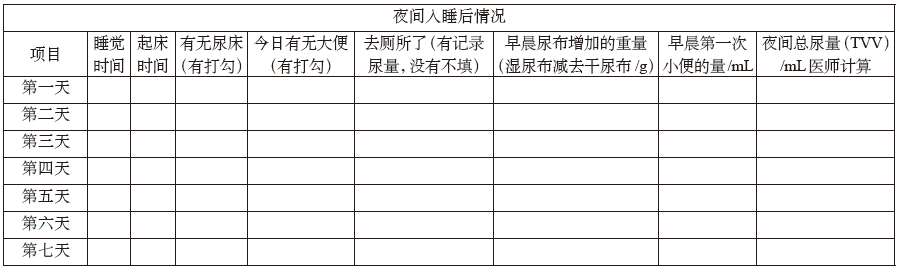 |
Table 3
Expected age-related bladder capacity and interpretation of maximum and total voided volume over night"
| 年 龄 | EBC | MVV最小阈值1) | TVV最大阈值2) |
|---|---|---|---|
| 5岁 | 180 | 117 | 234 |
| 6岁 | 210 | 137 | 273 |
| 7岁 | 240 | 156 | 312 |
| 8岁 | 270 | 176 | 351 |
| 9岁 | 300 | 195 | 390 |
| 10岁 | 330 | 215 | 429 |
| 11岁 | 360 | 234 | 468 |
| 12~18岁 | 390 | 254 | 507 |
Table 4
Suggested daily intake of drinks for children and young people"
| 年 龄 | 女 | 男 |
|---|---|---|
| 4~8岁 | 1 000~1 400 | 1 000~1 400 |
| 9~13岁 | 1 200~2 100 | 1 400~2 300 |
| 14~18岁 | 1 400~2 500 | 2 100~3 200 |
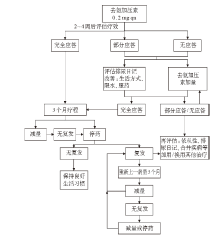
Figure 2
Follow-up and withdrawal strategy of desmopressin treatment with children in nocturnal enuresis"
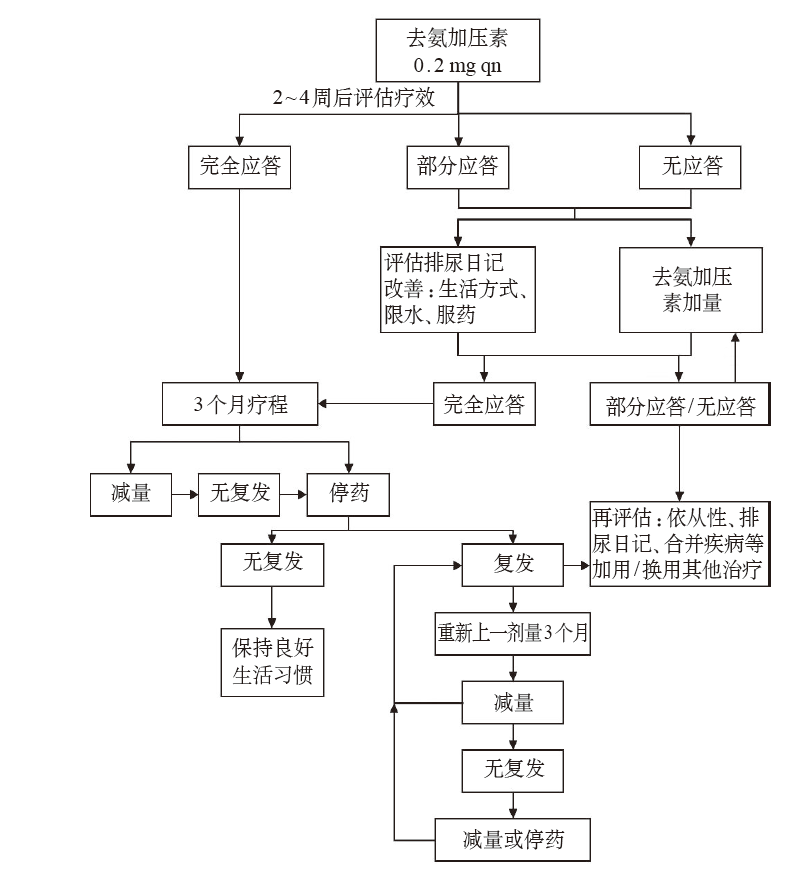
Table 5
Urotherapy recommendations for patients with LUTS"
| 1)正确的每日液体摄入量(表4) |
| 2)避免睡前2小时和夜间摄入液体 |
| 3)避免碳酸、富含咖啡因的饮料 |
| 4)全天规律饮食 |
| 5)适量的蛋白质和盐分的摄入 |
| 6)避免便秘——如必要,对其进行药物治疗 |
| 7)2~3小时定期排尿 |
| 8)避免尿液潴留在膀胱中 |
| 9)排尿时适当的姿势:排尿时伸直躯干,合适的马桶的高度(能够适当的用脚支撑) |
| [1] | 沈茜, 刘小梅, 姚勇, 等. 中国儿童单症状性夜遗尿疾病管理专家共识[J]. 临床儿科杂志, 2014, (10): 970-975. |
| Shen Q, Liu XM, Yao Y, et al. Expert Consensus on the Management of Monosymptomatic Nocturnal Enuresis in Chinese Children[J]. Linchuang Erke Zazhi, 2014, (10): 970-975. | |
| [2] | Wang TM, Yang SS, Tsai JD, et al. Management of nocturnal enuresis in Taiwan: Consensus statements of the Taiwan enuresis expert committee[J]. J Formos Med Assoc. 2019, 118(6):965-972. |
| [3] | 中华医学会小儿外科学分会小儿尿动力和盆底学组和泌尿外科学组. 儿童遗尿症诊断和治疗中国专家共识[J]. 中华医学杂志, 2019, 99 (21): 1615-1620. |
| The Pediatric Urodynamics and Pelvic Floor Group and the Urology Group of the Pediatric Surgery Branch of the Chinese Medical Association. Chinese Expert Consensus on Diagnosis and Treatment of Enuresis in Children[J]. Zhonghua Yixue Zazhi, 2019, 99 (21): 1615-1620. | |
| [4] |
Austin PF, Bauer SB, Bower W, et al. The standardization of terminology of lower urinary tract function in children and adolescents: update report from the standardization committee of the international children's continence society[J]. J Urol, 2014, 191(6): 1863-1865.
doi: 10.1016/j.juro.2014.01.110 pmid: 24508614 |
| [5] | Austin PF, Bauer SB, Bower W, et al. The standardization of terminology of lower urinary tract function in children and adolescents: Update report from the standardization committee of the International Children's Continence Society[J]. Neurourol Urodyn, 2016, 35(4): 471-481. |
| [6] | Nevéus T, Fonseca E, Franco I, et al. Management and treatment of nocturnal enuresis—an updated standardization document from the international children's continence society[J]. J Pediatr Urol, 2020, 16(1): 10-19. |
| [7] | Bastos JM Netto, Rondon AV, Lima GRMD, et al. Brazilian consensus in enuresis- recomendations for clinical practice[J]. Int Braz J Urol, 2019, 45: 889-900. |
| [8] | Bogaert G, Stein R, Undre S, et al. Practical recommen-dations of the eau‐espu guidelines committee for monosymptomatic enuresis—bedwetting[J]. Neurourol Urodyn, 2020, 39(2): 489-497. |
| [9] | The Japanese Society of Nocturnal Enuresis. Nocturnal Enuresis Clinical Practice Guidelines[M]. Tokyo: Diagnosis and Treatment Press, 2021. |
| [10] | Harris J, Lipson A, Dos Santos J. Evaluation and manage-ment of enuresis in the general paediatric setting[J]. Paediatr Child Health, 2023, 28(6): 362-376. |
| [11] | 陶洋旭, 李建军. 医疗共识制订方法:德尔菲法和名义小组法[J]. 国际眼科纵览, 2021, 45(5): 369-373. |
| Tao YX, Li JJ. Methods for developing medical consensus: Delphi method and nominal group technique[J]. Guoji Yanke Zonglan, 2021, 45(5): 369-373. | |
| [12] | Karničnik K, Koren A, Kos N, et al. Prevalence and quality of life of slovenian children with primary nocturnal enuresis[J]. Int J Nephrol, 2012: 509012. |
| [13] | Rangel RA, Seabra CR, Ferrarez CEPF, et al. Quality of life in enuretic children[J]. Int Braz J Urol, 2021, 47(3): 535-541. |
| [14] | 中国医师协会儿科医师分会肾脏疾病学组中国儿童遗尿疾病管理协作组. 中国5-18岁人群遗尿症患病率的横断面调查[J]. 中国循证儿科杂志, 2020, 15(02): 81-86. |
| Chinese Cooperative Group for the Management of Pediatric Enuresis Affiliated to Pediatric Nephrology Committee of Chinese Medical Doctor Association. Prevalence of nocturnal enuresis in children and adolescents aged 5 to 18 years in China[J]. Zhongguo Xunzheng Erke Zazhi, 2020, 15(2): 81-86. | |
| [15] | Zhong S, Lin X, Wang M, et al. Periaqueductal gray subregions connectivity and its association with micturition desire-awakening function[J]. Eur Child Adolesc Psychiatry, 2025, 34(4): 1435-1444. |
| [16] | Hyams JS, Di Lorenzo C, Saps M, et al. Childhood Functional Gastrointestinal Disorders: Child/Adolescent[J]. Gastroenterology, 2016, 15: S0016- 5085(16)00181-5. |
| [17] | Vande Walle J, Rittig S, Tekgül S, et al. Enuresis: practical guidelines for primary care[J]. Br J Gen Pract, 2017, 67(660): 328-329. |
| [18] |
Haid B, Tekgül S. Primary and secondary enuresis: pathophysiology, diagnosis, and treatment[J]. Eur Urol Focus, 2017, 3(2-3): 198-206.
doi: S2405-4569(17)30202-X pmid: 28888814 |
| [19] |
Koff SA. Estimating bladder capacity in children[J]. Urology, 1983, 21(3): 248.
doi: 10.1016/0090-4295(83)90079-1 pmid: 6836800 |
| [20] | Wang JJ, Wang DJ, Fu HD, et al. Evaluation of a new frequency-volume chart for children with primary monosymptomatic nocturnal enuresis: a prospective, comparative study[J]. World J Pediatr, 2021, 17(6): 643-652 |
| [21] | Iscan B, Ozkayın N. Evaluation of health-related quality of life and affecting factors in child with enuresis[J]. J Pediatr Urol, 2020, 16(2): 195.e1-195.e7. |
| [22] |
Hu HJ, Zhang ZW, Liang Y, et al. Prevalence, risk factors, and psychological effects of primary nocturnal enuresis in Chinese young adults[J]. Int Neurourol J, 2021, 25(1): 84-92.
doi: 10.5213/inj.2040398.149 pmid: 33819961 |
| [23] | National Clinical Guideline Centre (UK). Nocturnal Enuresis: The Management of Bedwetting in Children and Young People[M]. London: Royal College of Physicians (UK); 2010. |
| [24] |
Experience with the long-term use of desmopressin for nocturnal enuresis in children and adolescents[J]. BJU Int, 2002, 89(4): 420-425.
doi: 10.1046/j.1464-4096.2001.01546.x pmid: 11872036 |
| [25] |
Purnomo AF, Daryanto B, Nurhadi P. Monosymptomatic nocturnal enuresis treatment using alarm-therapy and desmopressin: a meta-analysis approach[J]. Med Arch, 2021, 75(6): 431-435.
doi: 10.5455/medarh.2021.75.431-435 pmid: 35169370 |
| [26] |
Kamperis K, Hagstroem S, Rittig S, et al. Combination of the enuresis alarm and desmopressin: second line treatment for nocturnal enuresis[J]. J Urol, 2008, 179(3): 1128-1131.
doi: 10.1016/j.juro.2007.10.088 pmid: 18206924 |
| [27] | Tsuji S, Kaneko K. Management of treatment-resistant nocturnal enuresis[J]. Pediatr Int, 2023, 65(1): e15573. |
| [28] | Liu J, Ni J, Miao Q, et al. Exploration of the optimal desmopressin treatment in children with monosymptomatic nocturnal enuresis: evidence from a Chinese cohort[J]. Front Pediatr. 2021, 8: 626083. |
| [29] | 初梅, 曹力, 陈朝英, 等. 醋酸去氨加压素中长程疗法治疗儿童原发性单症状夜遗尿症疗效研究[J]. 中国实用儿科杂志, 2017, 32(11): 861-865. |
| Chu M, Cao L, Chen ZY, et al. Efficacy of Long-term desmopressin acetate therapy for primary monosymptomatic nocturnal enuresis in children[J]. Zhongguo Shiyong Erke Zazhi, 2017, 32(11): 861-865. | |
| [30] | Chua ME, Silangcruz JM, Chang SJ, et al. Desmopressin withdrawal strategy for pediatric enuresis: a meta-analysis[J]. Pediatrics, 2016, 138(1): e20160495. |
| [31] |
Marschall-Kehrel D, Harms TW. Structured desmopressin withdrawal improves response and treatment outcome for monosymptomatic enuretic children[J]. J Urol, 2009, 182(4 Suppl): 2022-2026.
doi: 10.1016/j.juro.2009.03.068 pmid: 19695616 |
| [32] |
Ohtomo Y, Umino D, Takada M, et al. Gradual tapering of desmopressin leads to better outcome in nocturnal enuresis[J]. Pediatr Int, 2015, 57(4): 656-658.
doi: 10.1111/ped.12614 pmid: 25728739 |
| [33] | Kamperis K, Van Herzeele C, Rittig S, et al. Opti-mizing response to desmopressin in patients with monosymptomatic noc turnal enuresis[J]. Pediatr Nephrol, 2017, 32(2): 217-226. |
| [34] |
Dalrymple RA, Wacogne ID. Gradual withdrawal of desmopressin in patients with enuresis leads to fewer relapses than an abrupt withdrawal[J]. Arch Dis Child Educ Pract Ed, 2017, 102: 335.
doi: 10.1136/archdischild-2017-313000 pmid: 28468819 |
| [35] |
VandeWalle J, Stockner M, Raes A, et al. Desmopressin 30 years in clinical use: a safety review[J]. Curr Drug Saf, 2007, 2(3): 232-238.
pmid: 18690973 |
| [36] |
Wolfish NM, Barkin J, Gorodzinsky F, et al. The Canadian enuresis study and evaluation--short- and long-term safety and efficacy of an oral desmopressin preparation[J]. Scand J Urol Nephrol, 2003, 37(1): 22-27
pmid: 12745738 |
| [37] | Everaert K, Hervé F, Bosch R, et al. International continence society consensus on the diagnosis and treatment of nocturia[J]. Neurourol Urodyn, 2019, 38(2): 478-498. |
| [38] |
Lucchini B, Simonetti GD, Ceschi A, et al. Severe signs of hyponatremia secondary to desmopressin treatment for enuresis: a systematic review[J]. J Pediatr Urol, 2013, 9 (6 Pt B): 1049-1053.
doi: 10.1016/j.jpurol.2013.02.012 pmid: 23619353 |
| [39] |
Schulman SL, Stokes A, Salzman PM. The efficacy and safety of oral desmopressin in children with primary nocturnal enuresis[J]. J Urol, 2001, 166(6): 2427-2431.
pmid: 11696804 |
| [40] | Watanabe T, Ikeda H, Ono T, et al. Comparison of wireless and wired alarm devices for nocturnal enuresis treatment[J]. Pediatr Int, 2022, 64(1): e15328. |
| [41] |
Song P, Huang C, Wang Y, et al. Comparison of desmopressin, alarm, desmopressin plus alarm, and desmopressin plus anticholinergic agents in the management of paediatric monosymptomatic nocturnal enuresis: a network meta-analysis[J]. BJU Int, 2019, 123(3): 388-400.
doi: 10.1111/bju.14539 pmid: 30216627 |
| [42] | Caldwell PH, Codarini M, Stewart F, et al. Alarm interventions for nocturnal enuresis in children [DB/J]. Cochrane Database Syst Rev, 2020, 5(5): CD002911. |
| [43] |
Austin PF, Ferguson G, Yan Y, et al. Combination therapy with desmopressin and an anticholinergic medication for nonresponders to desmopressin for monosymptomatic nocturnal enuresis: a randomized, double-blind, placebo-controlled trial[J]. Pediatrics, 2008, 122(5): 1027-1032.
doi: 10.1542/peds.2007-3691 pmid: 18977983 |
| [44] |
Hodges SJ, Atala A. A randomized, double-blind, placebo-controlled trial of anticholinergic medication for nonresponders to desmopressin for monosymptomatic nocturnal enuresis[J]. Curr Urol Rep, 2011, 12(1): 1-2.
doi: 10.1007/s11934-010-0150-4 pmid: 20972651 |
| [45] | Yu J, Yan Z, Zhou S, et al. Desmopressin plus anti-cholinergic agent in the treatment of nocturnal enuresis: a meta-analysis[J]. Exp Ther Med, 2017, 14(4): 2875-2884. |
| [46] | Cai T, Yao Y, Sun W, et al. Desmopressin in combination with anticholinergic agents in the treatment of nocturnal enuresis: a systematic review and meta-analysis[J]. Front Pediatr, 2023, 11: 1242777. |
| [47] | Ghanavati PM, Khazaeli D, Amjadzadeh M. A comparison of the efficacy and tolerability of treating primary nocturnal enuresis with solifenacin plus desmopressin, tolterodine plus desmopressin, and desmopressin alone: a randomized controlled clinical trial[J]. Int Braz J Urol, 2021, 47(1): 73-81. |
| [48] |
Park SJ, Park JM, Pai KS, et al. Desmopressin alone versus desmopressin and an anticholinergic in the first-line treatment of primary monosymptomatic nocturnal enuresis: a multicenter study[J]. Pediatr Nephrol, 2014, 29(7): 1195-1200.
doi: 10.1007/s00467-014-2751-5 pmid: 24477979 |
| [49] | 徐虹, 丁洁, 易著文. 儿童肾脏病学[M]. 北京: 人民卫生出版社, 2018. |
| Xu H, Ding J, Yi ZW. Pediatric Nephrology[M]. Beijing: People's Medical Publishing House. 2018. | |
| [50] | Ramsay S, Lapointe É, Bolduc S. Comprehensive overview of the available pharmacotherapy for the treatment of non-neurogenic overactive bladder in children[J]. Expert Opin Pharmacother, 2022, 23(8): 991-1002. |
| [51] | Van Arendonk KJ, Austin JC, Boyt MA, et al. Frequency of wetting is predictive of response to anticholinergic treatment in children with overactive bladder[J]. Urology, 2006, 67(5): 1049e54. |
| [52] | Gish P, Mosholder AD, Truffa M, et al. Spectrum of central anticholinergic adverse effects associated with oxybutynin: comparison of pediatric and adult cases[J]. J Pediatr, 2009, 155(3): 432e4. |
| [53] | Rakowska-Silska M, Jobs K, Paturej A, et al. Voiding disorders in pediatrician’s practice[J]. Clin Med Insights Pediatr, 2020, 14: 1179556520975035. |
| [54] | Afshar K, Dos Santos J, Blais AS, et al. Canadian Urological Association guideline for the treatment of bladder dysfunction in children.[J] Can Urol Assoc J, 2021, 15(2): 13-18. |
| [55] |
Krhut J, Skugarevská B, Míka D, et al. Clinical utility of β3-adrenoreceptor agonists for the treatment of overactive bladder: a review of the evidence and current recommendations[J]. Res Rep Urol, 2022, 14: 167-175.
doi: 10.2147/RRU.S309144 pmid: 35502186 |
| [56] | Blais AS, Nadeau G, Moore K, et al. Prospective pilot study of mirabegron in pediatric patients with overactive bladder[J]. Eur Urol, 2016, 70(1): 9-13. |
| [57] | Fujinaga S, Watanabe Y, Nakagawa M. Efficacy of the novel selective b3-adrenoreceptor agonist vibegron for treatment-resistant monosymptomatic nocturnal enuresis in children[J]. Int J Urol, 2020, 27(8): 693-694. |
| [58] | Pillai RR, Sara B. Effectiveness of bladder retraining programme on bedwetting frequency and relapse rate of children with nocturnal enuresis[J]. J Pediatr Urol, 2024, 20(4): 602.e1-602.e12. |
| [59] |
Garcia-Fernandez A, Petros PE. A four month squatting-based pelvic exercise regime cures day/night enuresis and bowel dysfunction in children aged 7-11 years[J]. Cent European J Urol, 2020, 73(3): 307-314.
doi: 10.5173/ceju.2020.0044 pmid: 33133658 |
| [60] | Ebiloglu T, Ergin G, Irkilata HC, et al. The Biofeedback Treatment for Non-Monosymptomatic Enuresis Nocturna[J]. Neurourol Urodyn, 2016, 35(1): 58-61. |
| [61] |
Lindström S, Fall M, Carlsson CA, et al. The neurophysiological basis of bladder inhibition in response to intravaginal electrical stimulation[J]. J Urol, 1983, 129: 405-410.
doi: 10.1016/s0022-5347(17)52127-8 pmid: 6834523 |
| [62] |
Dutra MF, de Bessa J Júnior, et al. The effectiveness of parasacral transcutaneous electrical nerve stimulation in the treatment of monosymptomatic enuresis in children and adolescents: a systematic review[J]. Int Braz J Urol, 2024, 50(2): 136-151.
doi: 10.1590/S1677-5538.IBJU.2023.0618 pmid: 38386785 |
| [63] | Mcgrath KH, Caldwell PH, Jones MP. The frequency of constipation in children with nocturnal enuresis: a comparison with parental reporting[J]. J Paediatr Child Health, 2008, 44(1-2): 19-27. |
| [64] |
Hodges SJ, Anthony EY. Occult megarectum-a commonly unrecognized cause of enuresis[J]. Urology, 2012, 79(2): 421-424.
doi: 10.1016/j.urology.2011.10.015 pmid: 22173180 |
| [65] |
Kim JH, Lee JH, Jung AY, Lee JW. The prevalence and therapeutic effect of constipation in pediatric overactive bladder[J]. Int Neurourol J, 2011, 15(4): 206-210.
doi: 10.5213/inj.2011.15.4.206 pmid: 22259734 |
| [66] | Borch L, Hagstroem S, Bower WF, et al. Bladder and bowel dysfunction and the resolution of urinary incontinence with successful management of bowel symptoms in children[J]. Acta Paediatr, 2013, 102(5): e215-e220. |
| [67] |
Dal Pra A, Cury FL, Souhami L. Radiation therapy and androgen deprivation in the management of high risk prostate cancer[J]. Int Braz J Urol, 2011, 37(2):161-175.
pmid: 21557833 |
| [68] |
Baeyens D, Roeyers H, D'Haese L, et al. The prevalence of ADHD in children with enuresis: comparison between a tertiary and non-tertiary care sample[J]. Acta Paediatr. 2006, 95: 347-352.
doi: 10.1080/08035250500434736 pmid: 16497647 |
| [69] | Ding H, Wang M, Hu K, et al. Adenotonsillectomy can decrease enuresis and sympathetic nervous activity in children with obstructive sleep apnea syndrome[J]. J Pediatr Urol, 2017, 13(1): 41.e1-41.e8. |
| [70] | Tong C, He Q, Ho M, et al. Tuina for enuresis in children: a systematic review and meta-analysis of randomized controlled trials[J]. Front Public Health, 2022, 10: 821781. |
| [71] |
Ton G, Lin C, Ho W, et al. The effects of laser acupuncture therapy on nocturnal enuresis: a systematic review and meta-analysis[J]. Med Acupunct, 2022, 34(4): 228-239.
doi: 10.1089/acu.2022.0002 pmid: 36046465 |
| [72] | 王仲易, 杜可, 李晨, 等. 中医儿科临床诊疗指南·小儿遗尿症(修订)[J]. 中医儿科杂志, 2018, 14(1): 4-8. |
| Wang ZY, Du K, Li C, et al. Clinical practice guidelines for pediatrics in traditional chinese medicine - enuresis in children (revised)[J]. Zhongyi Erke Zazhi, 2018, 14(1): 4-8. | |
| [73] |
Sharifiaghdas F, Narouie B, Ahmadzade M, et al. Urodynamic findings in children with primary refractory nocturnal enuresis: 10 years' experience of a tertiary center[J]. Health Sci Rep, 2023, 6(10): e1626.
doi: 10.1002/hsr2.1626 pmid: 37829504 |
| [1] | LIN Jinfeng, CHEN Yi, DENG Yan, FENG Ai, HUANG Juan, CHEN Lizhu, XIE Jingqi, NIE Xiaojing. A comparative study on the detection of anti-Nephrin antibodies in children's nephrotic syndrome by chemiluminescence method and cell-based assay [J]. Journal of Clinical Pediatrics, 2026, 44(8): 682-689. |
| [2] | ZHENG Fangyuan, WANG Miao, DING Mingming, LU Aidong, JIA Yueping, ZENG Huimin, ZHANG Leping. Next-generation sequencing identified gene variants and their prognostic impact in pediatric Philadelphia chromosome positive acute lymphoblastic leukemia [J]. Journal of Clinical Pediatrics, 2026, 44(8): 690-697. |
| [3] | ZHANG Xiao, FANG Hongjun, KUANG Xiaojun, WANG Lijuan, WU Zhao, JIANG Sha, LI Pei, WU Liwen. Analysis of the clinical and electrophysiological characteristics of atonic seizures in children [J]. Journal of Clinical Pediatrics, 2026, 44(8): 698-704. |
| [4] | WANG Mengqian, YANG Hui. Case series analysis of 13 intestinal Behcet’s syndrome in children [J]. Journal of Clinical Pediatrics, 2026, 44(8): 705-711. |
| [5] | WU Xirong, GAO Qi, GUO Siyuan, YIN Qingqin, QIN Qiang, YIN Ju, JIAO Anxia, CHEN Chenghao, WU Di, WANG Bei, DUAN Xiaomin, PENG Yun, XU Baoping, GAO Liwei. Clinical characteristics and prognosis of pulmonary mucormycosis in children with diabetes mellitus [J]. Journal of Clinical Pediatrics, 2026, 44(8): 712-720. |
| [6] | HAN Yanan, GE Lanlan, CUI Jieyuan. A case report of branchio-oto-renal syndrome caused by EYA1 gene variant with a 6-year follow-up [J]. Journal of Clinical Pediatrics, 2026, 44(8): 721-726. |
| [7] | SHI Jiayi, GAO Chunlin, JIA Lili, LU Yunyun, SUN Tao, ZHU Xiaodong, XIA Zhengkun, ZHANG Pei. Phenotypic characteristics and prognostic analysis of a pedigree with childhood isolated nephrotic syndrome caused by compound heterozygous mutations in the COQ2 gene [J]. Journal of Clinical Pediatrics, 2026, 44(8): 727-732. |
| [8] | Rachel Rosen, Osvaldo Borrelli, Christophe Faure, Katja Karrento, Usha Krishnan, Samuel Nurko, Nathalie Rommel, Alan Silverman, Michiel van Wijk, Marc Benninga (Author), Chinese Medical Association Parenteral and Enteral Nutrition Branch Pediatrics Group, The Subspecialty Group of Gastroenterology, The Society of Pediatric, Chinese Medical Association, Gastroenterology Group, Pediatrician Branch, Chinese Medical Doctor Association (Translator). Core interpretation and explanation of Rome Ⅴ diagnostic criteria: upper gastrointestinal disorders of gut-brain interaction in children and adolescents [J]. Journal of Clinical Pediatrics, 2026, 44(7): 595-608. |
| [9] | Carlo Di Lorenzo, Miguel Saps, Bruno P. Chumpitazi, Shaman Rajindrajith, Annamaria Staiano, Nikhil Thapar, Miranda van Tilburg, Carlos Velasco-Benítez, Arine Vlieger (Author), Chinese Medical Association Parenteral and Enteral Nutrition Branch Pediatrics Group, The Subspecialty Group of Gastroenterology, The Society of Pediatric, Chinese Medical Association, Gastroenterology Group, Pediatrician Branch, Chinese Medical Doctor Association (Translator). Core interpretation and explanation of Rome Ⅴ diagnostic criteria: lower and biliary disorders of gut-brain interaction in children and adolescents [J]. Journal of Clinical Pediatrics, 2026, 44(7): 609-621. |
| [10] | LI Xufeng, TANG Haoxun, LI Xingjun, ZHANG Lize, GAO Chenqing, ZHAO Shunying, LIU Jianhua. Clinical characteristics, chest CT imaging phenotypes, and their correlation with prognosis in 76 children with Chlamydia pneumoniae pneumonia [J]. Journal of Clinical Pediatrics, 2026, 44(7): 622-627. |
| [11] | WANG Zhen, SHAO Jingbo, ZHANG Na, XIA Min, ZHU Jiashi, DU Chengkan, LI Hong. Factors influencing long-term recurrence in pediatric acute lymphoblastic leukemia patients with low-risk disease at initial diagnosis: a five-year follow-up analysis of 254 cases from a single center [J]. Journal of Clinical Pediatrics, 2026, 44(7): 628-635. |
| [12] | GUO Xuemei, XUE Yao, WANG Yongren, RONG Liucheng, FANG Yongjun, LIN Rufeng. Clinical features and prognosis of childhood acute myeloid leukemia with CBFA2T3::GLIS2 fusion [J]. Journal of Clinical Pediatrics, 2026, 44(7): 636-643. |
| [13] | YANG Lijun, FU Dongxia, CUI Yan, YANG Junmei, ZHANG Liming. Clinical manifestation and genetic analysis of CHARGE syndrome caused by CHD7 gene variation [J]. Journal of Clinical Pediatrics, 2026, 44(7): 644-650. |
| [14] | HU Yan, YANG Fan, LIANG Aimin, MAO Meng. Identification and management of faltering growth in children: insights from the 13th International Conference on Nutrition and Growth [J]. Journal of Clinical Pediatrics, 2026, 44(6): 485-488. |
| [15] | LIU Ziyao, WANG Congying, WANG Hongmao, ZHANG Mingming, XU Yingjie, LAI Jianming, NIU Wenquan, LI Xiaohui. Early differentiation of Kawasaki disease with joint symptoms and systemic juvenile idiopathic arthritis with Kawasaki disease-like symptoms: a single-center retrospective study [J]. Journal of Clinical Pediatrics, 2026, 44(6): 489-498. |
|
||
