

Journal of Clinical Pediatrics ›› 2025, Vol. 43 ›› Issue (5): 356-362.doi: 10.12372/jcp.2025.24e1359
• Original Article • Previous Articles Next Articles
LI Xuanxuan1,2, YANG Zhen3, CHEN Lin1, CAI Xiaoman1, LUO Wenyi1,4( )
Received:2024-12-18
Accepted:2025-03-07
Published:2025-05-15
Online:2025-05-09
LI Xuanxuan, YANG Zhen, CHEN Lin, CAI Xiaoman, LUO Wenyi. Revision and reliability and validity testing of the Tampa Scale for Kinesiophobia for children with heart disease[J].Journal of Clinical Pediatrics, 2025, 43(5): 356-362.

Table 1
Item content of the Kinesiophobia scale for children with heart disease and coefficient of variation (CV) values from expert evaluation"
| 条目内容 | 第一轮专家咨询 | 第二轮专家咨询 | ||
|---|---|---|---|---|
| 均数±标准差 | CV/% | 均数±标准差 | CV/% | |
| 1.我害怕在身体活动/体育锻炼中会伤到自己 | 4.70±0.68 | 14.36 | 4.78±0.44 | 9.23 |
| 2.如果我试着进行身体活动/体育锻炼,心脏问题就会加重 | 4.50±0.85 | 18.89 | 4.67±0.71 | 15.14 |
| 3.我感觉我的身体有严重的问题 | 4.60±0.70 | 15.20 | 4.60±0.70 | 15.20 |
| 4.如果我进行身体活动/体育锻炼,心脏问题可能会减轻 | 4.60±0.70 | 15.20 | 4.89±0.33 | 6.81 |
| 5.大家(家人/朋友等)对我的身体状况不够重视 | 4.60±0.70 | 15.20 | 4.78±0.67 | 13.95 |
| 6.我的心脏问题会让我的身体变得越来越差 | 4.90±0.32 | 6.45 | 54.90±0.32 | 6.45 |
| 7.一般情况下,出现心脏问题通常是因为身心受到了伤害或刺激 | 4.50±0.71 | 15.71 | 4.78±0.44 | 9.23 |
| 8.只引起胸部不舒服的事情不一定是危险的 | 4.60±0.70 | 15.20 | 4.67±0.50 | 10.71 |
| 9.我怕不小心在活动/锻炼中受伤 | 4.60±0.52 | 11.22 | 4.89±0.33 | 6.81 |
| 10.减少不必要的运动,心脏问题就不会越来越差 | 4.60±0.70 | 15.20 | 4.78±0.44 | 9.23 |
| 11.如果我的身体不受伤,我的心脏就不会出问题 | 4.30±0.95 | 22.07 | 4.78±0.44 | 9.23 |
| 12.我可以通过参加活动锻炼,来更好地保护心脏 | 4.50±1.97 | 21.60 | 4.56±0.53 | 11.56 |
| 13.当心脏不舒服或胸闷时,就提示我要不要停止活动或锻炼,这样就不会伤到我自己 | 4.20±1.03 | 24.60 | 4.67±0.71 | 15.14 |
| 14.对于像我这样身体状况的人来说,身体活动/体育锻炼真的不安全 | 4.70±0.68 | 14.36 | 4.89±0.33 | 6.81 |
| 15.我的心脏太容易出问题了,所以我无法和别人做同样的事情 | 4.70±0.68 | 14.36 | 4.70±0.68 | 14.36 |
| 16.尽管有些事会让我出现心脏问题,但我不觉得它们都是真正危险的 | 4.50±0.71 | 15.71 | 4.89±0.33 | 6.81 |
| 17.当一个人心脏有问题时,他/她应该不进行身体活动/体育锻炼 | 4.70±0.68 | 14.36 | 4.78±0.44 | 9.23 |
Table 2
Demographic characteristics of the study participants"
| 项 目 | 例数(%) |
|---|---|
| 性别 | |
| 男 | 149(50.70) |
| 女 | 145(49.30) |
| 文化程度 | |
| 小学 | 202(68.70) |
| 初中 | 67(22.80) |
| 高中/中专 | 25(8.50) |
| 疾病诊断 | |
| 左向右分流型先天性心脏病 | 164(55.80) |
| 梗阻型先天性心脏病 | 32(10.90) |
| 发绀型先天性心脏病 | 32(10.90) |
| 瓣膜性心脏病 | 31(10.50) |
| 充血性心力衰竭 | 15(5.10) |
| 肺动脉高压 | 15(5.10) |
| 房室传导阻滞 | 3(1.00) |
| 心脏移植术后 | 2(0.70) |
Table 3
Item analysis results of the Kinesiophobia scale for children with heart disease"
| 条 目 | 临界比(t) | P | 相关系数(r) | P |
|---|---|---|---|---|
| 1 | 13.00 | <0.001 | 0.66 | <0.001 |
| 2 | 12.65 | <0.001 | 0.64 | <0.001 |
| 3 | 14.19 | <0.001 | 0.65 | <0.001 |
| 4 | 4.32 | 0.039 | 0.25 | <0.001 |
| 5 | 2.04 | 0.044 | 0.07 | 0.227 |
| 6 | 9.31 | <0.001 | 0.53 | <0.001 |
| 7 | 7.36 | <0.001 | 0.47 | <0.001 |
| 8 | 3.58 | 0.204 | 0.27 | <0.001 |
| 9 | 10.94 | <0.001 | 0.58 | <0.001 |
| 10 | 9.32 | <0.001 | 0.55 | <0.001 |
| 11 | 6.34 | <0.001 | 0.44 | <0.001 |
| 12 | 7.59 | 0.613 | 0.43 | <0.001 |
| 13 | 1.77 | 0.079 | 0.13 | 0.026 |
| 14 | 10.95 | <0.001 | 0.65 | <0.001 |
| 15 | 8.84 | <0.001 | 0.50 | <0.001 |
| 16 | 3.69 | 0.192 | 0.29 | <0.001 |
| 17 | 10.74 | <0.001 | 0.60 | <0.001 |
Table 4
Rotated factor loadings, eigenvalues, and variance explained for the Kinesiophobia scale for children with heart disease"
| 项 目 | 因子1(运动恐惧) | 因子2(回避倾向) | 共同度 |
|---|---|---|---|
| 条目1 | 0.661 | 0.252 | 0.500 |
| 条目2 | 0.689 | 0.206 | 0.517 |
| 条目3 | 0.715 | 0.169 | 0.540 |
| 条目6 | 0.579 | 0.138 | 0.354 |
| 条目9 | 0.573 | 0.296 | 0.416 |
| 条目14 | 0.751 | 0.039 | 0.566 |
| 条目15 | 0.639 | -0.088 | 0.416 |
| 条目7 | 0.051 | 0.813 | 0.664 |
| 条目10 | 0.168 | 0.780 | 0.637 |
| 条目11 | 0.001 | 0.806 | 0.650 |
| 条目17 | 0.220 | 0.773 | 0.646 |
| 条目12 | -0.366 | 0.322 | 0.242 |
| 特征值 | 4.095 | 2.054 | |
| 累计贡献率/% | 28.159 | 51.241 |
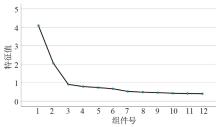
Figure 1
Scree plot of exploratory factor analysis for the fear of movement scale for children with heart disease"
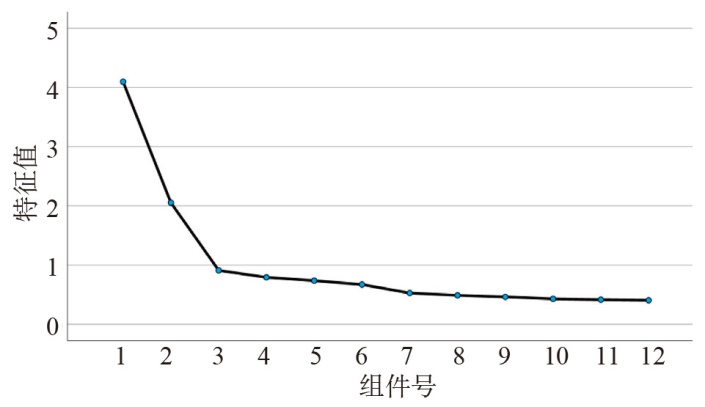
Table 5
Reliability analysis results of the Kinesiophobia scale for children with heart disease"
| 维 度 | Cronbach's α系数 | 折半信度 |
|---|---|---|
| 运动恐惧 | 0.811 | 0.772 |
| 回避倾向 | 0.820 | 0.830 |
| 量表总体 | 0.820 | 0.782 |
| 7~12岁 | 0.841 | 0.773 |
| 13~18岁 | 0.813 | 0.776 |
| [1] | 冯雪, 李四维, 刘红樱, 等. 中西医结合冠状动脉旁路移植术Ⅰ期心脏康复专家共识[J]. 中国循环杂志, 2017, 32(4): 314-317. |
| Feng X, Li SW, Liu HY, et al. Expert consensus on phase I cardiac rehabilitation for coronary artery bypass grafting with integrated traditional Chinese and western medicine[J]. Zhongguo Xunhuan Zazhi, 2017, 32(4): 314-317. | |
| [2] | Callaghan S., Morrison M. L., Mckeown P. P., et al. Exercise prescription improves exercise tolerance in young children with CHD: a randomised clinical trial[J]. Open Heart, 2021, 8(1): e001599. |
| [3] | 王诗瑜, 张宇扬, 陈阳, 等. 运动康复训练对先天性心脏病术后患儿干预效果的meta分析[J]. 护理管理杂志, 2023, 23(7): 551-555. |
| Wang SY, Zhang YY, Chen Y, et al. The effect of exercise rehabilitation training on children with congenital heart disease after surgery: a meta-analysis[J]. Huli Guanli Zazhi, 2023, 23(7): 551-555. | |
| [4] | Meyer M, Brudy L, Fuertes-Moure A, et al. E-health exercise intervention for pediatric patients with congenital heart disease: a randomized controlled trial[J]. J Pediatr, 2021, 233: 163-168. |
| [5] | Voss C, Duncombe SL, Dean PH, et al. Physical activity and sedentary behavior in children with congenital heart disease[J]. J Am Heart Assoc, 2017, 6(3): e004665. |
| [6] |
Mccrindle BW, Williams RV, Mital S, et al. Physical activity levels in children and adolescents are reduced after the fontan procedure, independent of exercise capacity, and are associated with lower perceived general health[J]. Arch Dis Child, 2007, 92(6): 509-514.
doi: 10.1136/adc.2006.105239 pmid: 17307794 |
| [7] |
Stone N, Obeid J, Dillenburg R., et al. Objectively measured physical activity levels of young children with congenital heart disease[J]. Cardiol Young, 2015, 25(3): 520-525.
doi: 10.1017/S1047951114000298 pmid: 24666760 |
| [8] | Shen XY, Chen L, Yuan L, et al. Analysis of prescription compliance and influencing factors in cardiac rehabilitation after surgery in children with congenital heart disease based on generalized trust theory[J]. Eur J Cardiovasc Nurs, 2024, 23(6): 627-634. |
| [9] | Chen CW, Chen YC, Gau BS, et al. Exercise behavior in adolescents with mild congenital heart disease[J]. J Cardiovasc Nurs, 2012, 27(4): 317-324. |
| [10] |
Van Deutekom AW, Lewandowski AJ. Physical activity modification in youth with congenital heart disease: a comprehensive narrative review[J]. Pediatr Res, 2021, 89(7): 1650-1658.
doi: 10.1038/s41390-020-01194-8 pmid: 33049756 |
| [11] | Kori S. Kinesiophobia:a new view of chronic pain behaviour[J]. Pain Manag, 1990, 3(1): 35-43. |
| [12] |
Bäck M, Jansson B, Cider A, et al. Validation of a questionnaire to detect kinesiophobia (fear of movement) in patients with coronary artery disease[J]. J Rehabil Med, 2012, 44(4): 363-369.
doi: 10.2340/16501977-0942 pmid: 22366980 |
| [13] | 雷梦杰, 刘婷婷, 熊司琦, 等. 心脏病患者运动恐惧量表的汉化及信度效度检验[J]. 中国护理管理, 2019, 19(11): 1637-1642. |
| Lei MJ, Liu TT, Xiong SQ, et al. Reliability and validity test of Chinese version of the Tampa Scale for Kinesiophobia Heart[J]. Zhongguo Huli Guanli, 2019, 19(11): 1637-1642. | |
| [14] | 袁曦临. 认知发展视域下儿童阅读分级指导策略研究[J]. 图书馆杂志, 2023, 42(7): 62-69. |
| Yuan XL. Study on the guidance strategies of children's leveled reading in Chinese from the perspective of cognitive development[J]. Tushuguan Zazhi, 2023, 42(7): 62-69. | |
| [15] | 蔡小满, 邓娟, 李萌, 等. 儿童及青少年先天性心脏病康复中国专家共识[J]. 中国循环杂志, 2024, 39(12): 1156-1169. |
| Cai XM, Deng J, Li M, et al. Chinese expert consensus on rehabilitation of congenital heart disease in children and adolescents[J]. Zhongguo Xunhuan Zazhi, 2024, 39(12): 1156-1169. | |
| [16] | 蔡小满, 徐卓明, 徐毅超, 等. 先天性心脏病患儿心脏矫正术后心肺运动功能评估的初步实践[J]. 中华心血管病杂志, 2022, 50(5): 471-479. |
| Cai XM, Xu ZM, Xu YC, et al. Preliminary practice in the postoperative cardiopulmonary exercise testing for children with congenital heart disease[J]. Zhonghua Xinxueguan Zazhi, 2022, 50(5): 471-479. | |
| [17] |
张丽娟, 孙建云, 尹志勇. 心外科高流量氧疗患者运动恐惧水平及影响因素[J]. 中国临床护理, 2024, 16(3): 188-192.
doi: 10.3969/j.issn.1674-3768.2024.03.013 |
| Zhang LJ, Sun JY, Yin ZY. The level of Kinesiophobia and its influencing factors in cardiac surgery patients receiving high-flow oxygen therapy[J]. Zhongguo Linchuang Huli, 2024, 16(3): 188-192. | |
| [18] | 贾钰, 郭慧芳, 李双双, 等. 心脏起搏器植入患者运动恐惧的评估与干预研究进展[J]. 中国护理管理, 2023, 23(11): 1692-1697. |
| Jia Y, Guo HF, Li SS, et al. Research progress on the assessment and intervention of Kinesiophobia in patients with pacemaker implantation[J]. Zhongguo Huli Guanli, 2023, 23(11): 1692-1697. | |
| [19] | 白井双, 蔡立柏, 白中乐, 等. 心脏起搏器植入术后恐动症患者早期功能锻炼体验的质性研究[J]. 中华现代护理杂志, 2021, 27(27): 3648-3653. |
| Bai JS, Cai LB, Bai ZL, et al. A qualitative study on the early functional exercise experience of patients with Kinesiophobia after pacemaker implantation[J]. Zhong hua xian da hu li za zhi, 2021, 27(27): 3648-3653. | |
| [20] | 徐蔼婷. 德尔菲法的应用及其难点[J]. 中国统计, 2006(9): 57-59. |
| Xu AT. The application of the Delphi method and its challenges[J]. Zhongguo Tongji, 2006(9): 57-59. | |
| [21] | 李灿, 辛玲. 调查问卷的信度与效度的评价方法研究[J]. 中国卫生统计, 2008, 25(5): 541-544. |
| Li C, Xin L. Research on the evaluation methods of reliability and validity of questionnaires[J]. Zhongguo Weisheng Tongji, 2008, 25(5): 541-544. | |
| [22] |
王之惠, 任永霞, 史宇红, 等. 弱视儿童视功能相关生活质量量表的编制及信效度检验[J]. 中华护理杂志, 2022, 57(20): 2507-2514.
doi: 10.3761/j.issn.0254-1769.2022.20.011 |
| Wang ZH, Ren YX, Shi YH, et al. Development and psychometric validation of a vision-related quality of life scale for children with amblyopia[J]. Zhonghua Huli Zazhi, 2022, 57(20): 2507-2514. | |
| [23] | 方积乾. 生存质量测定方法及应用[M]. 北京: 北京医科大学出版社, 2000. |
| Fang JQ. Measurement methods and applications of quality of life[M]. Beijing: Beijing Medical University Press, 2000. | |
| [24] |
Lethem J, Slade PD, Troup JD, et al. Outline of a fear-avoidance model of exaggerated pain perception--I[J]. Behav Res Ther, 1983, 21(4): 401-408.
doi: 10.1016/0005-7967(83)90009-8 pmid: 6626110 |
| [1] | LIN Jinfeng, CHEN Yi, DENG Yan, FENG Ai, HUANG Juan, CHEN Lizhu, XIE Jingqi, NIE Xiaojing. A comparative study on the detection of anti-Nephrin antibodies in children's nephrotic syndrome by chemiluminescence method and cell-based assay [J]. Journal of Clinical Pediatrics, 2026, 44(8): 682-689. |
| [2] | ZHENG Fangyuan, WANG Miao, DING Mingming, LU Aidong, JIA Yueping, ZENG Huimin, ZHANG Leping. Next-generation sequencing identified gene variants and their prognostic impact in pediatric Philadelphia chromosome positive acute lymphoblastic leukemia [J]. Journal of Clinical Pediatrics, 2026, 44(8): 690-697. |
| [3] | ZHANG Xiao, FANG Hongjun, KUANG Xiaojun, WANG Lijuan, WU Zhao, JIANG Sha, LI Pei, WU Liwen. Analysis of the clinical and electrophysiological characteristics of atonic seizures in children [J]. Journal of Clinical Pediatrics, 2026, 44(8): 698-704. |
| [4] | WANG Mengqian, YANG Hui. Case series analysis of 13 intestinal Behcet’s syndrome in children [J]. Journal of Clinical Pediatrics, 2026, 44(8): 705-711. |
| [5] | WU Xirong, GAO Qi, GUO Siyuan, YIN Qingqin, QIN Qiang, YIN Ju, JIAO Anxia, CHEN Chenghao, WU Di, WANG Bei, DUAN Xiaomin, PENG Yun, XU Baoping, GAO Liwei. Clinical characteristics and prognosis of pulmonary mucormycosis in children with diabetes mellitus [J]. Journal of Clinical Pediatrics, 2026, 44(8): 712-720. |
| [6] | HAN Yanan, GE Lanlan, CUI Jieyuan. A case report of branchio-oto-renal syndrome caused by EYA1 gene variant with a 6-year follow-up [J]. Journal of Clinical Pediatrics, 2026, 44(8): 721-726. |
| [7] | SHI Jiayi, GAO Chunlin, JIA Lili, LU Yunyun, SUN Tao, ZHU Xiaodong, XIA Zhengkun, ZHANG Pei. Phenotypic characteristics and prognostic analysis of a pedigree with childhood isolated nephrotic syndrome caused by compound heterozygous mutations in the COQ2 gene [J]. Journal of Clinical Pediatrics, 2026, 44(8): 727-732. |
| [8] | Rachel Rosen, Osvaldo Borrelli, Christophe Faure, Katja Karrento, Usha Krishnan, Samuel Nurko, Nathalie Rommel, Alan Silverman, Michiel van Wijk, Marc Benninga (Author), Chinese Medical Association Parenteral and Enteral Nutrition Branch Pediatrics Group, The Subspecialty Group of Gastroenterology, The Society of Pediatric, Chinese Medical Association, Gastroenterology Group, Pediatrician Branch, Chinese Medical Doctor Association (Translator). Core interpretation and explanation of Rome Ⅴ diagnostic criteria: upper gastrointestinal disorders of gut-brain interaction in children and adolescents [J]. Journal of Clinical Pediatrics, 2026, 44(7): 595-608. |
| [9] | Carlo Di Lorenzo, Miguel Saps, Bruno P. Chumpitazi, Shaman Rajindrajith, Annamaria Staiano, Nikhil Thapar, Miranda van Tilburg, Carlos Velasco-Benítez, Arine Vlieger (Author), Chinese Medical Association Parenteral and Enteral Nutrition Branch Pediatrics Group, The Subspecialty Group of Gastroenterology, The Society of Pediatric, Chinese Medical Association, Gastroenterology Group, Pediatrician Branch, Chinese Medical Doctor Association (Translator). Core interpretation and explanation of Rome Ⅴ diagnostic criteria: lower and biliary disorders of gut-brain interaction in children and adolescents [J]. Journal of Clinical Pediatrics, 2026, 44(7): 609-621. |
| [10] | LI Xufeng, TANG Haoxun, LI Xingjun, ZHANG Lize, GAO Chenqing, ZHAO Shunying, LIU Jianhua. Clinical characteristics, chest CT imaging phenotypes, and their correlation with prognosis in 76 children with Chlamydia pneumoniae pneumonia [J]. Journal of Clinical Pediatrics, 2026, 44(7): 622-627. |
| [11] | WANG Zhen, SHAO Jingbo, ZHANG Na, XIA Min, ZHU Jiashi, DU Chengkan, LI Hong. Factors influencing long-term recurrence in pediatric acute lymphoblastic leukemia patients with low-risk disease at initial diagnosis: a five-year follow-up analysis of 254 cases from a single center [J]. Journal of Clinical Pediatrics, 2026, 44(7): 628-635. |
| [12] | GUO Xuemei, XUE Yao, WANG Yongren, RONG Liucheng, FANG Yongjun, LIN Rufeng. Clinical features and prognosis of childhood acute myeloid leukemia with CBFA2T3::GLIS2 fusion [J]. Journal of Clinical Pediatrics, 2026, 44(7): 636-643. |
| [13] | YANG Lijun, FU Dongxia, CUI Yan, YANG Junmei, ZHANG Liming. Clinical manifestation and genetic analysis of CHARGE syndrome caused by CHD7 gene variation [J]. Journal of Clinical Pediatrics, 2026, 44(7): 644-650. |
| [14] | ZHAO Liudan, ZHOU Xin, SUN Kun. Research progress on artificial intelligence-assisted heart sound recognition for congenital heart disease [J]. Journal of Clinical Pediatrics, 2026, 44(7): 665-672. |
| [15] | HU Yan, YANG Fan, LIANG Aimin, MAO Meng. Identification and management of faltering growth in children: insights from the 13th International Conference on Nutrition and Growth [J]. Journal of Clinical Pediatrics, 2026, 44(6): 485-488. |
|
||
